
Burnsville Wood Flooring does water damaged hardwood floor repair in Burnsville, MN, serving surrounding cities including Apple Valley, Savage, Bloomington, Eagan, Richfield. Twenty-plus years in this market means most of these calls arrive in two clusters: January and February, when ice dams and frozen pipes send water into the house from above, and spring, when groundwater and backups send it up from the lower level.
The first thing we do is not carpentry. It is a moisture meter, a grid of readings, and a photographic record of the floor exactly as it is before anyone touches it. That record is what your claim is built on, and it cannot be recreated after the boards are in a dumpster. It also scopes the job honestly, because the wet area is almost always larger than the part that looks wet.
The second thing is patience. A floor dried carefully often flattens back out and keeps its remaining sanding life; a floor torn out on day two is a replacement invoice that may never have been necessary. We would rather run readings for three weeks and save the wood than remove it on the first visit.
Where Minnesota Floor Water Actually Comes From
Ice Dams and Meltwater Entering From Above
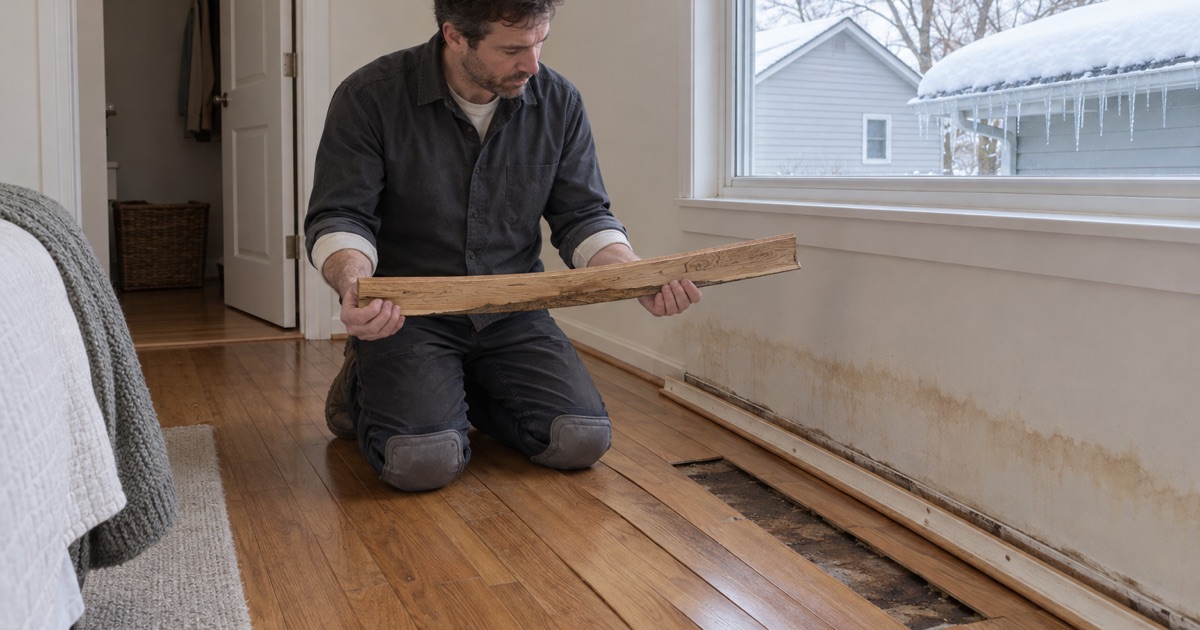
Snow melts on a warm roof deck, refreezes at the cold eave, and the resulting dam backs water up under the shingles and into the wall or ceiling below. It reaches flooring by running down inside the framing and emerging along an exterior wall, which is why the cupping often forms a band parallel to the outside of the house. Tracing that pattern back to its entry point matters before repair is quoted.
Pipes Freezing in an Exterior Wall or Unheated Space
A supply line in an outside wall, a garage wall, or an unheated crawlspace can freeze, split, and then release water only when it thaws — sometimes days later, sometimes while nobody is home. These are the losses that soak the most flooring, because the water runs unattended. The failure point is often several rooms away from where the floor shows damage, so the search follows the joists rather than the visible cupping.
Basement Backups, Sump Failures and Appliance Leaks
Lower-level flooring takes water from a different direction: a failed sump pump during a spring thaw, a sewer backup, or a water heater that gives out. Slow appliance leaks belong in the same category even though they are not dramatic — a dishwasher or refrigerator line weeping for months does more damage per gallon than a burst pipe, because the wood never gets a chance to dry between exposures.
Assessing a Wet Floor Before Anything Comes Out
Metering the Full Extent, Not the Visible Extent
We take readings in a grid, working outward from the source until they return to the baseline elsewhere in the house, and mark the boundary. Water wicks along the length of boards and travels under cabinets, so a wet area routinely extends several feet past the last board that looks affected. Repairing only to the visible edge is how a job gets reopened in April.
Checking the Subfloor, Not Just the Flooring
The flooring can be salvageable while the plywood or OSB underneath it is not, and that is the reading that determines whether this is a repair or a replacement. Saturated sheathing loses fastener holding power and can delaminate, and putting a dried floor back down over it produces squeaks and movement within a year. Where there is access from below, we read the subfloor from underneath as well.
Deciding Whether the Floor Can Dry in Place
A floor that is cupped but sound, over a subfloor that is drying, is usually a candidate for controlled drying and a later sanding. A floor with buckled boards, adhesive failure on a glue-down, delaminated engineered wear layers, or standing water that sat for a week is generally not. That call gets made from readings and from what the boards physically look like, not from how bad the room looks on day one.
Drying, Salvage and Replacement
Controlled Drying and Why Speed Is the Enemy
Drying too aggressively pulls moisture out of the top of the board faster than the bottom can release it, which cracks finish, splits faces and turns a cupped floor into a crowned and checked one. The target is slow and even, with readings recorded through the process. We dry until the flooring and subfloor readings stabilize and match the rest of the house, then wait before doing anything to the surface.
Partial Replacement Woven Into a Dried Floor
Where some boards are lost and the surrounding floor survives, the replacements go in with their ends staggered into the existing field so no seam lines up, matched for species, cut and width. The whole affected run is then sanded through the full grit sequence and finished as one surface. Done this way, the boundary between old and new stops being findable once the finish is on.
When Replacement Is the Right Answer
Sometimes it is: engineered flooring whose wear layer has delaminated cannot be saved, a floor already sanded to the tongue has no recovery left in it, and a subfloor that has to come out takes the flooring with it. When that is the case we say so early and document why, because a replacement decision made and evidenced on day two is a very different conversation with a carrier than one made after the demolition.
Documentation and the Insurance Claim
Photographs and Readings Before Any Demolition
We photograph the affected area, the source, the boundary of the wet zone and the subfloor condition, and we record the meter readings with them. That package goes to you. It exists because the single most common way a flooring claim goes badly is that the floor was removed before anyone documented what it was, how far the damage ran, and what species, grade and finish it had.
Like Kind and Quality, and Depreciation
Minnesota Statutes 72A.201 lists as unfair practices settling under replacement value provisions for less than the sum necessary to replace the damaged item with one of like kind and quality, and reducing an offer for depreciation on items not adversely affected by age, use or obsolescence. Documenting the actual species, grade, width and finish of what was there is what makes those provisions do any work for you.
What We Do Not Do, and Why That Matters
We are a flooring contractor, not your adjuster and not your carrier. We do not tell you what your policy covers, quote a settlement figure, or promise that a loss will be paid — coverage lives in the policy wording and the carrier’s determination. What we provide is an accurate, dated, measured record of the damage and a scope written in the terms an adjuster reads, which is the part that is genuinely ours to get right.
- 20+ Years Experience
- Free Written Estimates
- Dust Containment on Every Sand