
Burnsville Wood Flooring installs, refinishes and maintains commercial wood flooring in Burnsville, MN and across the south metro. Over 20+ years that has meant restaurant dining rooms, retail sales floors, office reception areas, church halls and institutional corridors — spaces where the floor is a finish, an asset and an operating constraint all at once, and where taking it out of service costs the client money by the hour.
Commercial work differs from residential in three specific ways rather than in general ambition. The traffic is heavier and more concentrated. The schedule is dictated by the building’s operations rather than by the trade. And the specification has to survive being reviewed by somebody who was not in the room when the decision was made, which is why we put species, construction, substrate treatment and finish system in writing.
The other difference is that a commercial floor is almost always part of a longer arrangement. A residential client wants their floor done; a commercial client wants to know what it will cost to keep it presentable for ten years. That second question is the one worth answering properly at the start.
Commercial Spaces and What Each Asks of a Floor
Restaurants, Bars and Food Service
Food service is the hardest environment a wood floor sees short of a loading dock: constant spot loading from chair legs, spills that are not always addressed immediately, cleaning regimes involving water, and traffic concentrated into service lanes that never move. Species selection matters here, but finish system and a realistic recoat interval matter more. We are direct about which areas will need attention first.
Retail, Office and Institutional Spaces
Retail floors take rolling fixtures and continuous footfall along predictable paths, so wear is uneven by design and planned for. Office and institutional spaces are gentler underfoot but bring their own constraints — sound transmission between tenants, coordination with other trades on a build-out, and access windows that are often narrow. The specification follows from those constraints rather than from a catalog.
Specification: Species, Construction and Substrate
Choosing Species and Construction for the Load
Janka hardness is a useful comparison and a poor sole criterion, because it measures resistance to indentation rather than to the abrasion and rolling loads that actually wear a commercial floor. Grain character matters too: an open-grained white oak or hickory disguises traffic marks that show plainly on hard maple. Engineered core construction is often the right answer over slab and in conditioned commercial spaces with wide seasonal swings.
Testing the Slab and Preparing the Substrate
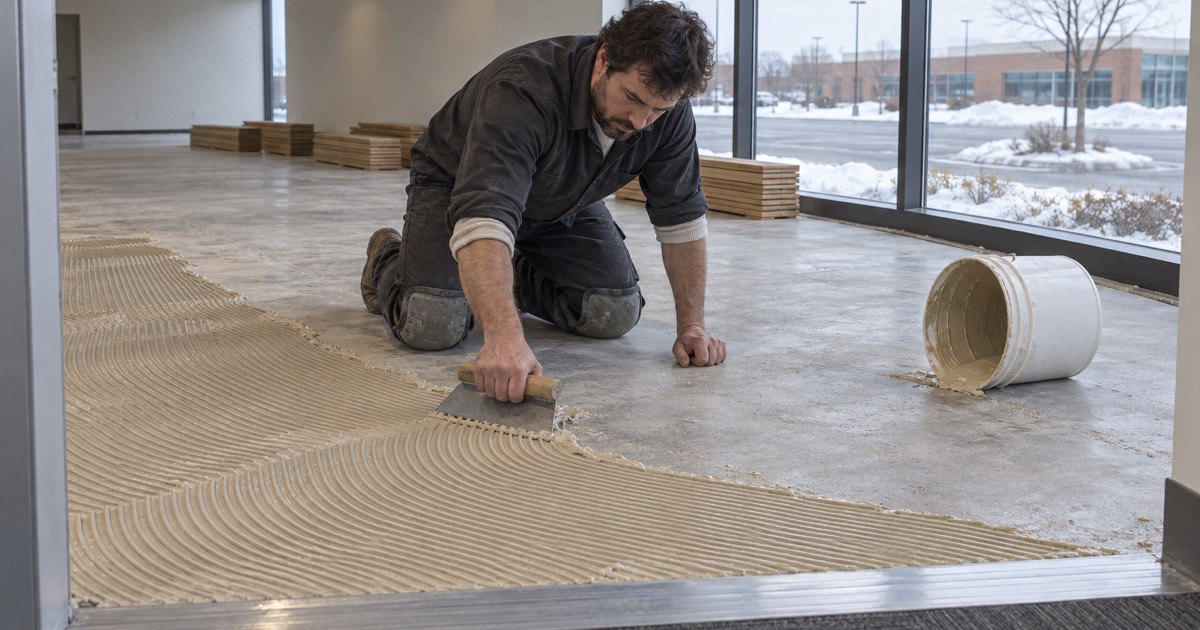
Most commercial installations sit on concrete, and the slab is tested before anything is specified. ASTM F2170 in-situ relative humidity probe testing is the governing method, and the number that matters is the acceptance threshold published by the specific flooring or adhesive manufacturer. Flatness is checked against the product’s tolerance and corrected with self-leveling underlayment where it falls short, since adhesive telegraphs everything beneath it.
Finish Selection and Coating Requirements
Matching the Finish System to the Traffic
Commercial-grade waterborne finishes give fast recoat windows and low odor, which matters enormously when the space has to reopen. Two-component systems build a harder film for heavy traffic areas. Sheen is a functional decision rather than only an aesthetic one, since a matte or satin surface disguises the fine scratching that any high-traffic floor accumulates, while gloss displays every mark under overhead lighting.
Volatile Organic Compound Limits on Architectural Coatings
Architectural coatings sold and applied in Minnesota fall under the federal standards at 40 CFR Part 59, Subpart D, and the category that applies depends on the product’s chemistry — varnishes, sealers, sanding sealers and lacquers each carry their own limit, and a clear interior wood finish is not the federal category called floor coating. We specify against the product’s actual classification and against whatever the building’s own ventilation and occupancy allow.
Phasing, Downtime and Maintenance Programs
Working Around Operating Hours
Most commercial refinishing is done overnight or over a closure, phased so a defined area is out of service at a time and the rest of the space keeps working. Containment matters more here than in a house, since dust reaching a kitchen, a sales floor or an occupied office is a problem beyond housekeeping. We set the phase boundaries and the nightly scope in the proposal rather than improvising them on site.
Scheduled Recoating as an Operating Cost
The cheapest way to own a commercial wood floor is to recoat it on an interval that keeps the finish film intact, because recoating spends no wood and a full sand does. We look at the actual traffic pattern and propose an interval for the space rather than a generic figure, and we would rather flag an area needing earlier attention than let a client discover bare wood in the service lane.
- 20+ Years Experience
- Free Written Estimates
- Dust Containment on Every Sand