Hardwood Floors Refinished, Repaired and Installed in Burnsville

Twenty years of Minnesota hardwood, with the moisture and humidity readings written down before we quote.

Burnsville Wood Flooring has spent 20+ years refinishing, repairing and installing hardwood floors in Burnsville, Minnesota and across the south metro. We sand and recoat worn oak, replace water-damaged boards, build and refinish hardwood stairs, and install solid and engineered flooring in houses, townhomes and commercial spaces. Every job starts the same way: a moisture meter on the flooring, a moisture meter on the subfloor, and a hygrometer reading of the indoor relative humidity, written down before we quote anything.

That order matters more here than it does in most of the country. Wood flooring is specified to live between thirty and fifty percent relative humidity, and a heated Minnesota house routinely drops below thirty percent from December through March without supplemental humidification. A floor installed at the wrong moisture content, or judged as failed in February, gets torn out for reasons that had very little to do with the wood.

So we measure first and quote second. You get a written grit sequence and finish schedule with the estimate, so the work can be checked against something rather than taken on trust. The crew that walks the job at the estimate is the crew that lays the final coat. And where a screen-and-recoat will do what you actually want done, we say so, even when the full sand-and-refinish is the larger invoice.

Get Your Free Quote

Fast response • No obligation

So we can reach you about your request.

So we can send you a confirmation after you submit this inquiry form.

  • 20+ Years Experience
  • Free Written Estimates
  • Dust Containment on Every Sand

What we do

Our Services

Hardwood floor refinishing, repair and installation in Burnsville, Minnesota

Worker running an edger along the perimeter of a Burnsville living room where the field of the red oak floor has already been cut back to bare wood.

Hardwood Floor Refinishing

Full sand-and-refinish for worn hardwood in Burnsville, with a written grit sequence and finish schedule handed over alongside the quote.

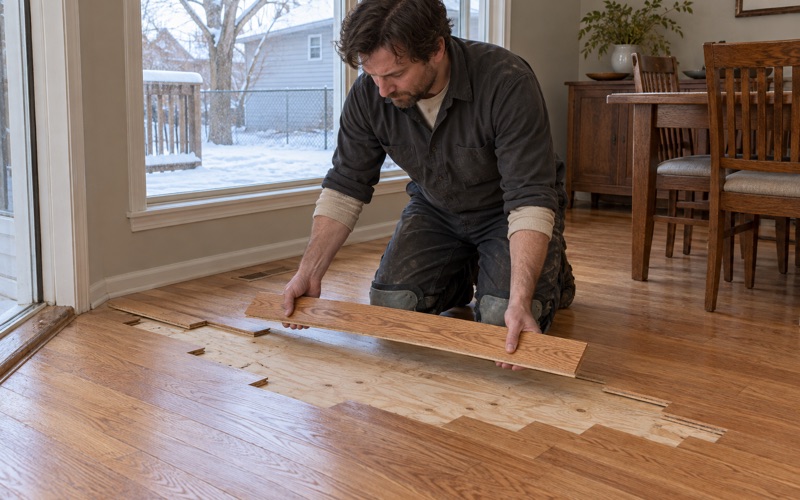
Carpenter lowering a cut oak plank into a laced-in repair in a Burnsville floor, the new boards staggered into the old rather than cut as a block.

Hardwood Floor Repair

Board replacement, squeak repair, water damage and invisible patching for hardwood floors in Burnsville and the surrounding south metro.

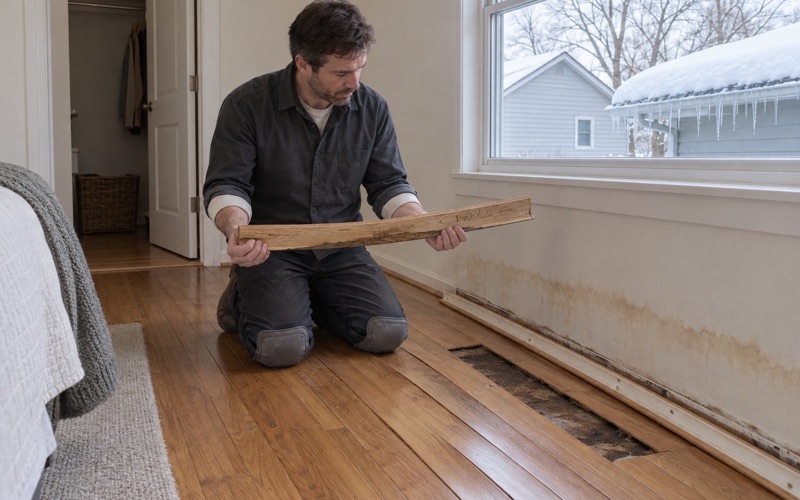
Restorer holding a cupped oak board taken out of a Burnsville floor below an ice-dam stain, the boards on either side still crowned up along the outside wall.

Water Damaged Hardwood Floor Repair

Ice dam, burst pipe and basement water damage to hardwood floors in Burnsville, documented for the claim before anything is torn out.

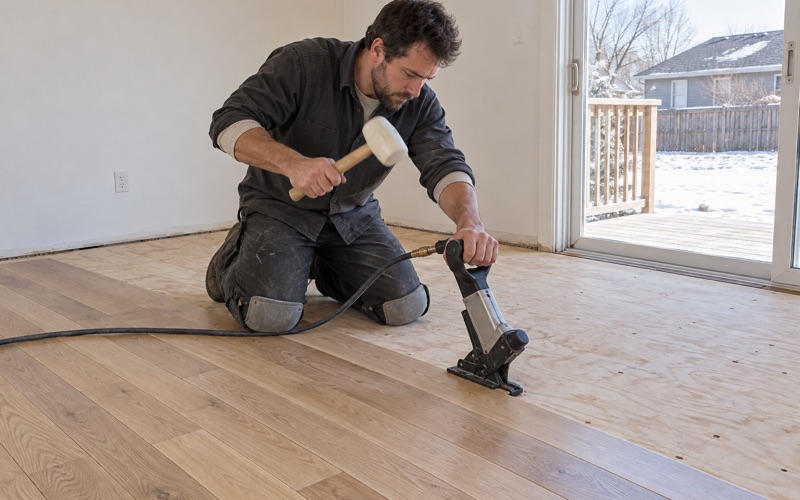
Installer striking a flooring nailer seated on the tongue edge of a white oak board in a Burnsville house, the run advancing across a plywood subfloor.

Hardwood Floor Installation

Solid and engineered hardwood installed in Burnsville homes, with acclimation measured to a moisture target rather than counted off a calendar.

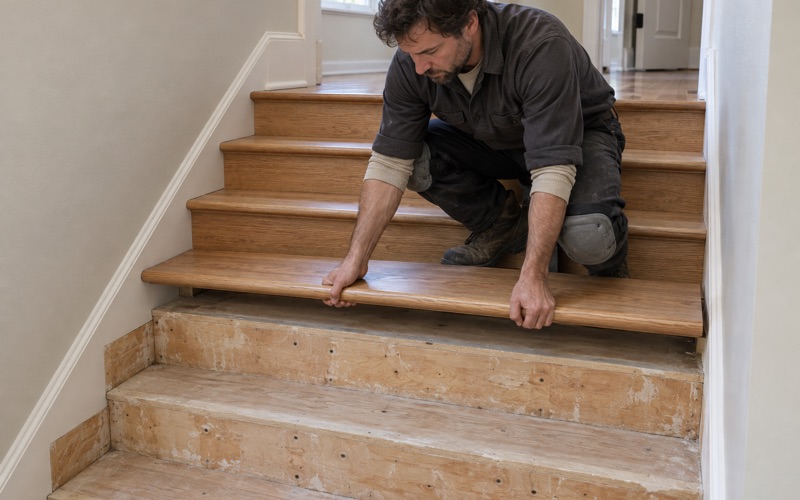
Joiner setting a retro tread with a bullnose front edge onto an open stringer in a Burnsville split-level stairway, the nosing overhanging the riser below.

Hardwood Stairs

Carpet-to-wood stair conversions, new treads and risers, and refinishing for existing hardwood stairs in Burnsville and the south metro.

Operator running a buffer across a white oak floor in a Burnsville house during a screen and recoat, the sheen breaking evenly ahead of the machine.

Screen And Recoat Hardwood Floors

Abrading the existing finish and laying fresh topcoats over it — the cheaper option where a floor's finish is worn but not worn through.

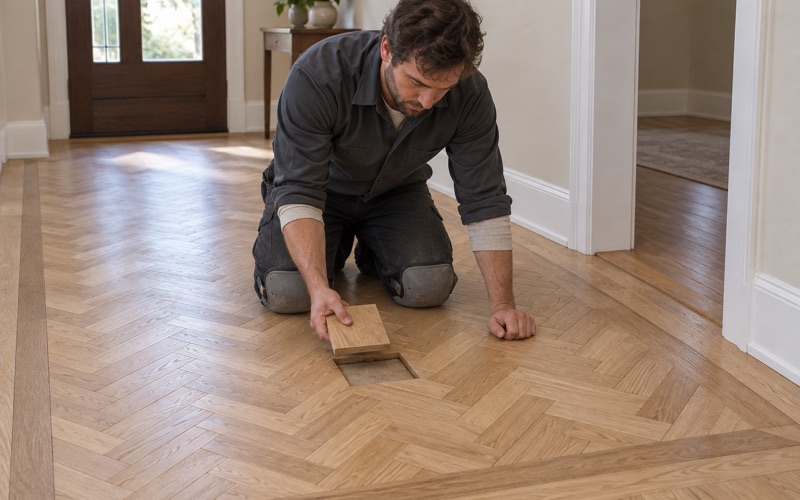
Worker seating a replacement parquet block into a herringbone field in a Burnsville house, the surrounding blocks sanded back to bare oak.

Parquet Floor Refinishing

Refinishing wood parquet in Burnsville homes, sanded across the block pattern rather than with a grain that runs four directions at once.

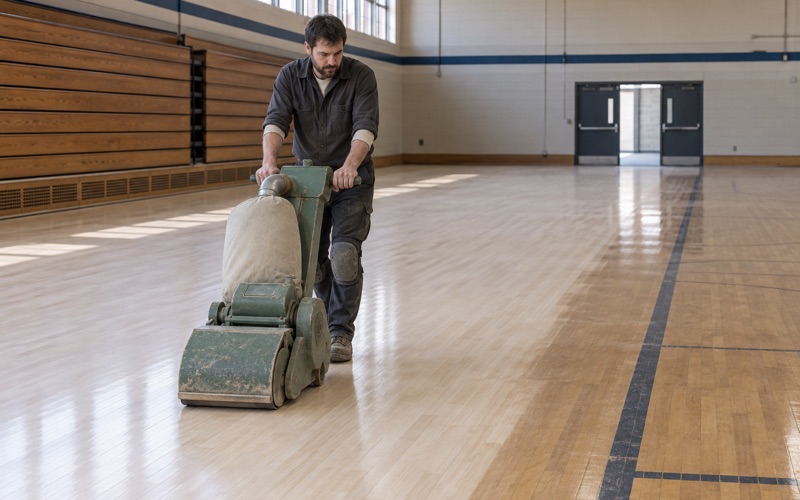
Operator running a belt sander across a maple gym floor in the Burnsville area, old game lines half cut away and bleachers folded flat against the wall.

Gym Floor Refinishing

Sanding, game line layout and recoating for hard maple gym floors in schools, churches and athletic facilities across the south metro.

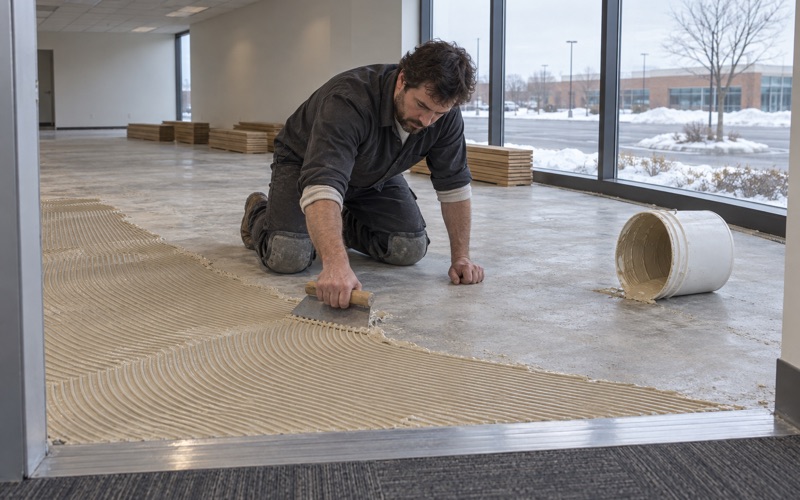
Installer spreading adhesive with a notched trowel across the concrete deck of a Burnsville commercial suite, engineered oak planks stacked flat against the wall.

Commercial Wood Flooring

Installation, refinishing and scheduled recoat programs for wood floors in Burnsville retail, restaurant, office and institutional spaces.

Twenty Years on Minnesota Hardwood

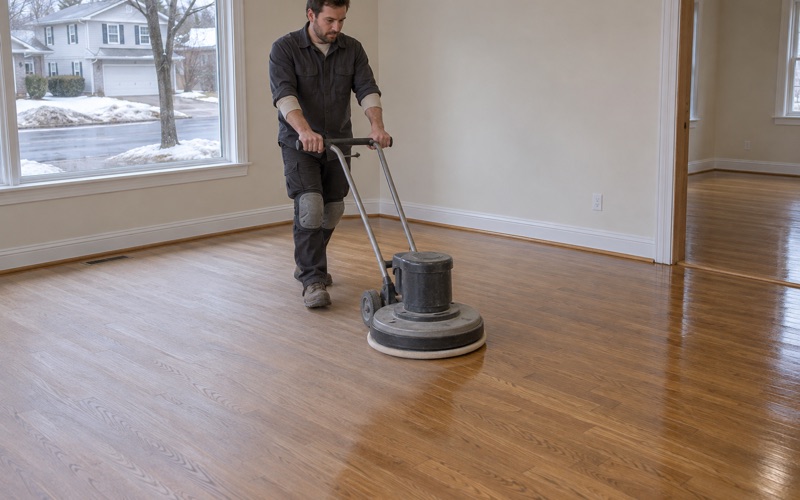
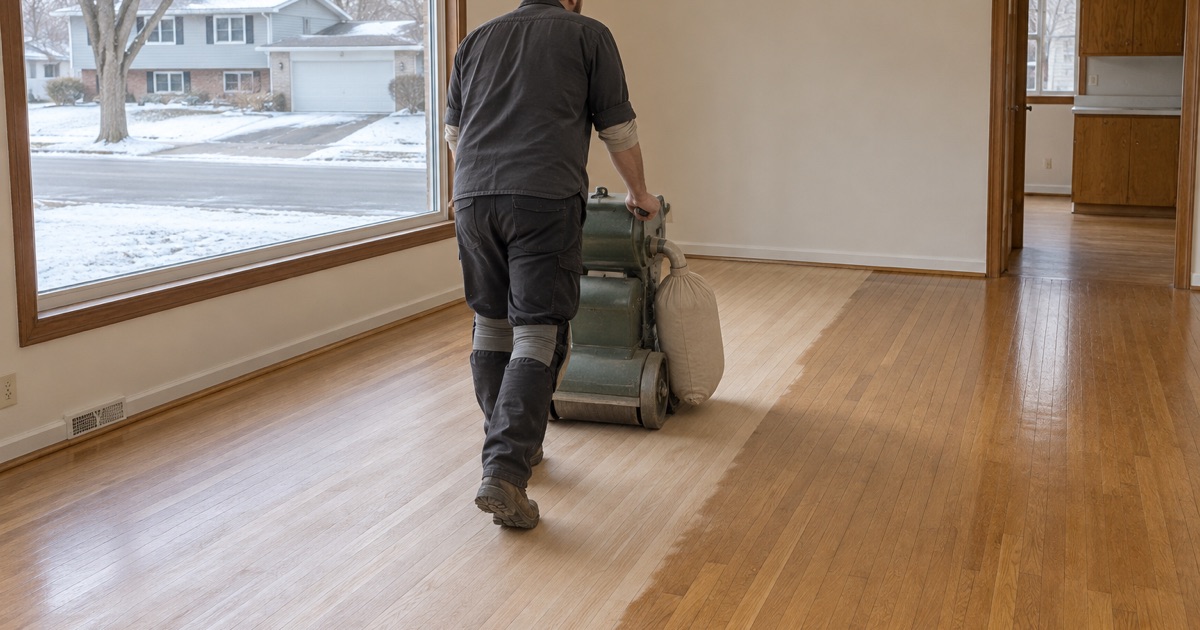
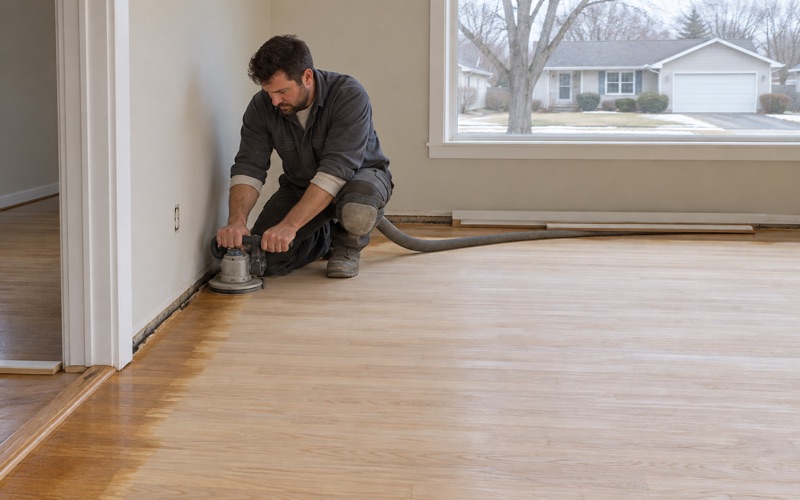
Worker running a drum sander across the red oak floor of a Burnsville split-level, half the room cut back to bare wood and half still carrying its old amber finish.

Two Decades of Floors in the South Metro

Burnsville Wood Flooring has worked on Minnesota hardwood for more than 20 years, which is long enough to have seen the same floors twice — once at installation and again at the recoat a decade later. That span is the reason we will quote a recoat honestly against a full refinish: we know which one a given floor will still be fine with in five years, because we have gone back and looked.

Why Choose Burnsville Wood Flooring

Humidity Read Before the Quote

Every estimate starts with a hygrometer reading written down on the spot, because wood flooring is specified for a thirty to fifty percent relative humidity band and most heated Minnesota houses fall out of it by January. That means the floor gets planned around the house it will actually live in through February, rather than around the mild October afternoon it happened to be measured on.

Two Moisture Readings, Not One

No board goes down until the moisture content of the flooring and the moisture content of the subfloor have been checked against each other, with the differential held inside the NWFA installation guidelines — four percent generally, and two percent for a nail-down over plywood. A floor laid across a wider gap than that moves afterward, so the checking happens beforehand rather than as a diagnosis in spring.

Wear Layer Measured Before a Refinish Is Quoted

Never do we quote a refinish on engineered flooring without measuring the wear layer first, because past a certain thickness there is nothing left to sand and the drum sander finds that out at the worst possible moment. Where the layer is too thin, we say so and price a screen-and-recoat or a replacement instead of taking money for a sand-through.

Winter Gapping Explained, Not Billed

Gaps that open between boards in January get measured and explained before anyone calls the floor defective, because roughly one-sixteenth to one-eighth of an inch of seasonal movement is commonly normal in a well-maintained Minnesota floor and a good share of it closes again by June. A contractor selling a refinish in February on gapping alone is selling you the season rather than a repair.

Association Paperwork Sorted Before the Crew Arrives

Board approval and building rules get settled before an upstairs job starts in a townhome or condominium, so nobody arrives to find the work stopped halfway through with the old floor already gone. Minnesota code sets sound transmission class 45 and impact insulation class 45 for townhouses and two-family dwellings, and a building’s own declaration and rules frequently ask for more than that.

Minnesota Winters and What They Do to a Wood Floor

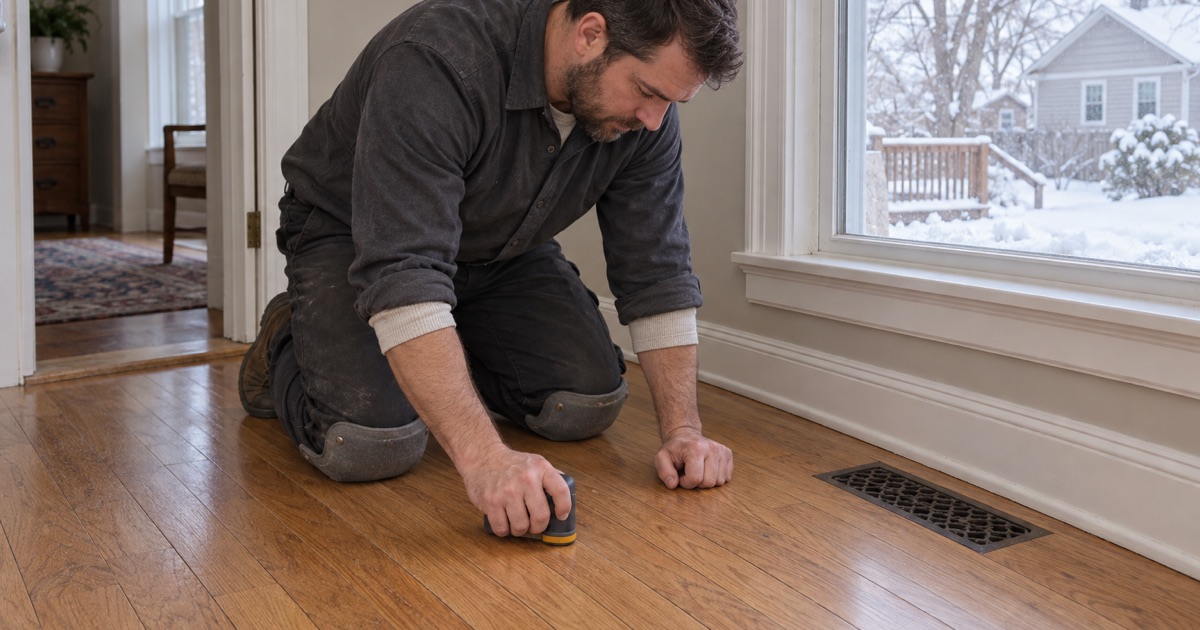
Worker pressing a moisture meter flat to a red oak board in a Burnsville house during the heating season, thin seasonal gaps open between the strips and frost on the window behind him.

Why Winter Gaps Open and June Closes Them Again

Wood gives up moisture to dry indoor air and shrinks across the grain, so the seams between boards widen through the heating season and narrow again as outdoor humidity returns. Gaps of roughly one-sixteenth to one-eighth of an inch are commonly normal in a well-maintained floor. We photograph and measure them in February so there is a record to compare against in June, before anybody pays for a repair that the calendar was going to perform for free.

The Thirty to Fifty Percent Humidity Band Wood Flooring Needs

Hardwood flooring is specified to live between thirty and fifty percent relative humidity at sixty to eighty degrees Fahrenheit, and the whole warranty structure behind it assumes those conditions. Minnesota homes routinely fall below thirty percent through the heating season without supplemental humidification. We write the reading down on the first visit so the number is a fact in the file rather than something argued about after the floor moves.

Why a Tight, Well-Insulated House Gaps Worse

An older leaky house pulls in enough outdoor air to keep some moisture moving through it, while a tight, well-sealed one simply holds the dry heated air it makes. The result runs against intuition: the better-built house often carries the lower winter relative humidity and shows the wider seasonal gapping. We size humidification to the house that is actually there, measured, rather than to its age or its build quality.

Whole-House Humidifiers, Portable Units and What Each One Moves

A whole-house humidifier tied into forced-air heating conditions the air the floor lives in everywhere the ducts reach, which is what a wood floor actually needs. A portable unit raises the room it sits in and very little else, so it can hold one room inside the band while the rest of the floor keeps drying out. We tell you which one your floor’s square footage requires before you buy either.

Engineered Floors That Dry-Cup in Winter

Solid flooring usually cups when the underside is wetter than the top, which is a summer and a basement problem. Engineered flooring can do the opposite in a Minnesota January: the dry wear layer shrinks faster than the stable core beneath it and the board dry-cups. The fix for that is humidity, not sanding — a dry-cupped floor sanded flat in February comes back crowned in July.

Reading a Hygrometer Before Deciding a Floor Has Failed

A hygrometer costs less than an hour of labor and answers most winter floor complaints outright. If the house is sitting at eighteen percent relative humidity, the boards are doing exactly what boards do and no amount of refinishing changes that. We take the reading first and bring it into the conversation, because a floor condemned in the wrong season is an expensive and entirely avoidable mistake.

Acclimation as a Moisture Target Rather Than a Calendar

“Let it sit three days” is the most repeated bad instruction in this trade. Acclimation is finished when the flooring reaches equilibrium moisture content with the conditions it will live in, measured with a moisture meter at normal living temperature and humidity, at a minimum of twenty locations per 1,000 square feet. We hold delivery until the house is at living conditions, then measure until the number stops moving.

Ice Dams, Frozen Pipes and Water Reaching a Floor From Above

Minnesota’s flooring water losses come from three places above the floor: an ice dam backing meltwater under the shingles, a pipe freezing in an exterior wall, and a fixture on the story above. Water travels along joists and surfaces as cupping several feet from where it entered. We map the wet zone with a moisture meter before deciding what comes out, because guessing costs boards that were fine.

Refinishing, Recoating and Bringing a Floor Back

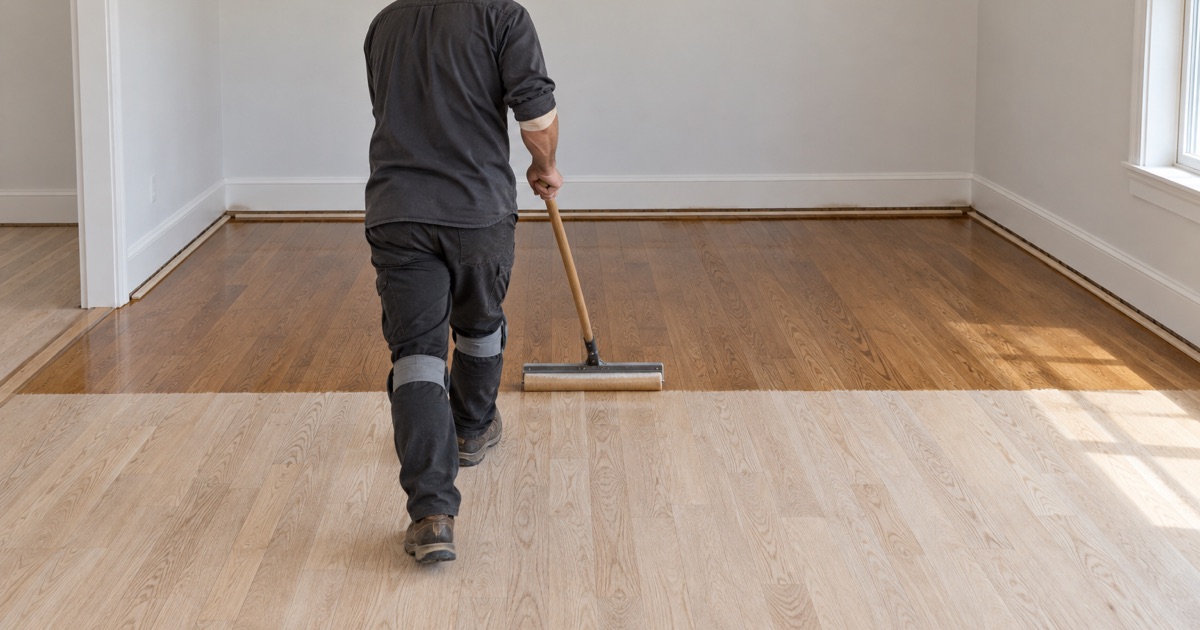
Finisher walking backwards with an applicator as the first coat goes down over freshly sanded white oak in a Burnsville house, the wet edge running straight across the room.

A Full Sand-and-Refinish Against a Screen-and-Recoat

A refinish takes the floor back to bare wood and resets color, depth of scratch and flatness together. A screen-and-recoat abrades the existing finish with an abrasive screen and lays fresh coats over the top — cheaper, faster, and useless once the wear has gone through to the wood. We quote both against each other honestly and say plainly when the cheaper one is the right one for the floor in front of us.

The Thirty-Six, Fifty and Eighty Grit Sequence

The first cut with a thirty-six grit takes off the old finish and levels overwood and previous sanding marks. The fifty grit removes the scratch the thirty-six left behind, and the eighty grit removes the fifty’s, each pass erasing the one before it rather than adding polish of its own. Skipping a grit shows up as visible swirl under the finish, which is why the sequence goes in writing on the quote.

Waterborne, Oil-Modified and Hardwax Oil Finishes

Waterborne polyurethane dries clear, stays close to the raw color of the wood and returns the house to use fastest. Oil-modified polyurethane ambers over time, which flatters red oak and fights a white oak floor that was chosen to stay pale. Hardwax oil sits in the wood rather than over it, spot-repairs without a full recoat, and asks for a maintenance routine the other two do not.

Dust Containment During Sanding, and What It Does Not Catch

Every sanding job here runs containment on the drum sander, the edger and the buffer, which captures the great majority of what those machines throw into the air. It does not catch everything, and we will not pretend otherwise: fine dust still settles for a day or two, and it finds open shelving and the tops of door casings. Saying that in advance is cheaper for everyone than saying it afterward.

How Many Times a Floor Can Be Sanded

Solid three-quarter-inch flooring has usable wood only down to the tongue, and once a sander reaches that point the floor is finished as a floor. That depth is several full refinishes if each one is cut at the right grit and no deeper than the damage requires. Every unnecessary aggressive pass spends the budget early, so we take the least material that will do the job and tell you what is left.

Measuring the Wear Layer on Engineered Flooring

Engineered flooring can only be refinished down to the top of its core, and wear layers run from a paper-thin veneer to several millimeters of real hardwood. We measure at a vent cut or a threshold before quoting anything, because a sander that reaches the core turns a cosmetic problem into a full replacement. Where the layer is too thin, a recoat or board-by-board replacement is the honest answer to give.

Stain Color Tested on Your Own Floor

Stain reads differently on red oak than on white oak, differently on quartersawn than on plainsawn stock, and differently again on an old board that has spent thirty years under a rug. We sand a panel of your actual floor and put the candidate colors on it, then look at them in your own light at the time of day you use the room. A showroom sample board answers a different question entirely.

Pet Stains, Black Spots and What Sanding Will Not Remove

Surface scratches, gray weathering and ordinary traffic wear all sand out cleanly. Black spots are usually urine that reached the wood and reacted with the tannins in it, and that stain frequently runs deeper than the sanding budget allows. We test a spot before promising anything at all, and price board replacement or a weave-in patch wherever the color is not going to come out.

When Something Has Gone Wrong

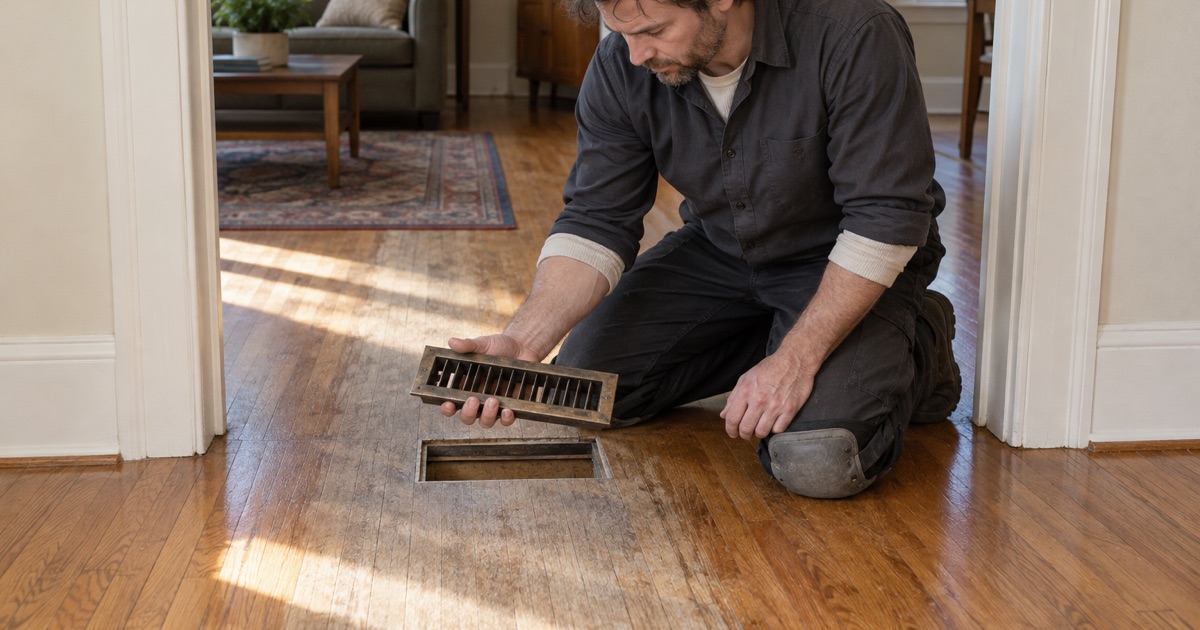
Technician holding up a lifted floor register beside a Burnsville doorway where the finish has worn through to bare oak, the register’s cut edge showing what is left of the board.

Cupping, Crowning and Buckling as Moisture Symptoms

Cupping — edges high, center low — means the underside is wetter than the top, and it points at a crawlspace, a slab or a slow leak rather than at the flooring itself. Crowning is the reverse and often follows a floor that was sanded flat while it was still cupped. Buckling is the board leaving the subfloor entirely, and it means the expansion gap ran out. We find the water first.

Squeaks, and Whether the Fix Comes From Above or Below

A squeak is movement between two things: board against board, board against fastener, or subfloor against joist. Where there is access from below, the fix is quiet and invisible — blocking and screws driven into the subfloor from the basement or crawlspace. Where there is no access, it has to be done from the face of the floor, and we say which one your house allows before starting.

Boards That Have Gone Hollow Underfoot

A hollow sound is flooring that has lost contact with the subfloor: adhesive that released on a glue-down, staples or cleats that pulled on an old nail-down, or a low spot the original installer never leveled. We map the affected area, open the smallest section that answers the question, and re-fasten or re-bed rather than replacing sound wood that only ever needed holding down.

Board Replacement and Weaving a Patch Into the Field

A patch that reads as a patch is a failure even when the carpentry behind it is good. We pull the damaged boards, stagger the new ends into the surrounding field so no seam lines up in a row, and match species, cut and width before the sander ever touches it. On a site-finished floor the area is then sanded and finished as one surface, so the repair disappears into the floor.

Water Damage From a Burst Pipe, an Ice Dam or a Basement Backup

Wet flooring does not fail evenly, and the visible cupping is rarely the full extent of what got wet. We meter outward from the source until the readings match the rest of the house, then decide what dries in place and what has to come out. Drying a floor that can be saved is usually far cheaper than replacing it, but only where the subfloor underneath it is dry as well.

Documenting a Damaged Floor Before Anything Is Torn Out

Photographs, moisture readings and the measured extent of the affected area all get recorded before demolition, because once the boards are in a dumpster the claim rests on your word alone. Minnesota Statutes 72A.201 addresses settlement under replacement value provisions with material of like kind and quality, and reducing an offer for depreciation on items not adversely affected by age or use. Documentation is what makes those provisions usable.

Small Round Holes and Fine Powder in Oak Flooring

Powderpost beetles attack the large-pored hardwoods — oak, ash, hickory and pecan — and leave emergence holes about one-sixteenth of an inch across with fine, flour-like frass beneath them. They do not attack softwoods such as pine or spruce, so the species of the floor tells you a great deal immediately. We identify the pest and its extent before any flooring comes out, because treatment and replacement are different jobs.

Matching a Discontinued Floor When Only Part Is Damaged

Species, cut, width, grade and finish all have to line up, and a discontinued prefinished floor rarely gives you all five at once. Sometimes the answer is boards lifted from a closet or from under an appliance and reused in the visible field, with the new material hidden where nobody looks. Where nothing matches well enough, we say so early rather than after the repair is half finished.

New Floors: Choosing, Installing, and Where Wood Belongs

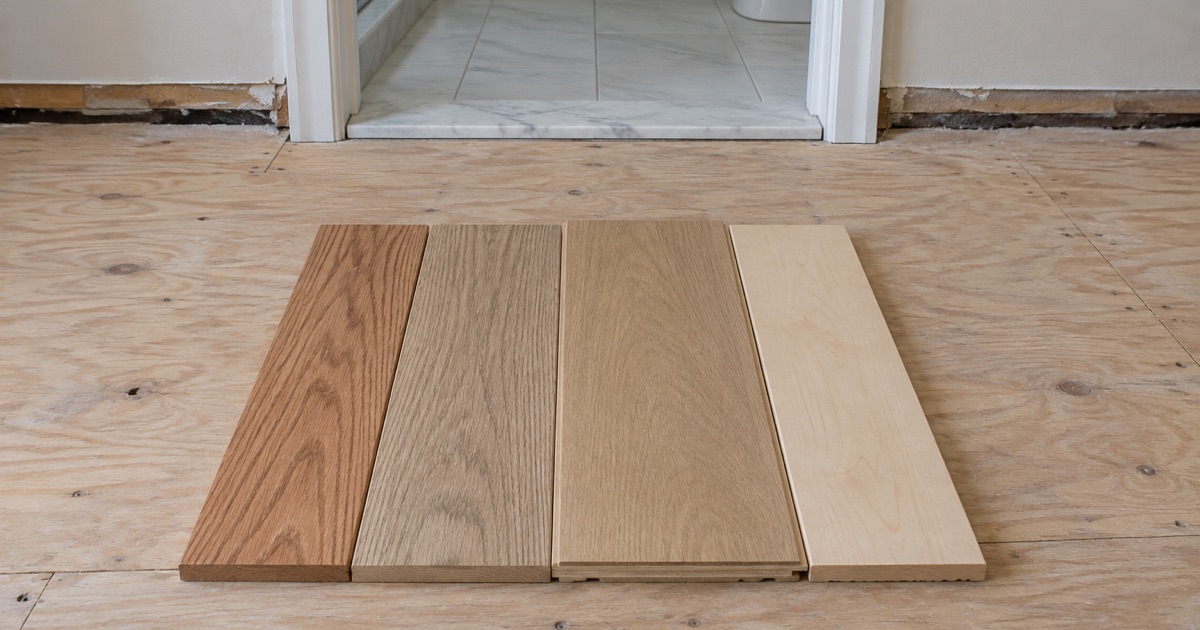
Four flooring samples laid side by side on the plywood subfloor of a Burnsville house at the tile threshold, showing the choices and where wood stops.

Solid and Engineered Flooring, and Where Each One Belongs

Solid hardwood can be sanded many times over its life and belongs on or above grade over a wood subfloor. Engineered core construction is dimensionally more stable across humidity swings, which is what puts it over a slab, over radiant heat, or anywhere below grade is under discussion. The trade-off is refinishing life, and that is exactly why the wear layer is the number that matters when you buy it.

Basements and Lower Levels Below Grade

A below-grade slab moves moisture upward year-round, and a solid floor over it will cup, gap or buckle no matter how carefully it was installed. We test the slab with an in-situ relative humidity probe under ASTM F2170 and read the flooring manufacturer’s own acceptance threshold, because that number belongs to the product rather than to us. Often the honest answer below grade is that wood is the wrong material for the room.

White Oak, Red Oak, Hard Maple, Hickory and American Walnut

Red oak’s open grain and pink undertone hide traffic well and take stain forgivingly; white oak is tighter, cooler in color and the default for a modern pale floor. Hard maple sits higher on the Janka hardness scale but blotches under stain and shows dents cleanly. Hickory is harder still with dramatic color variation, and American walnut is softer and darker, worth its price for looks rather than for durability.

Nail-Down, Glue-Down and Floating Installations

Nail-down with cleats or staples is the standard for solid flooring over a plywood or OSB subfloor, and the fastener gauge and spacing schedule are what keep it quiet for twenty years. Glue-down bonds engineered flooring directly to the slab or subfloor and transmits the least impact sound. A floating floor is fastened to neither, which makes it fast, reversible, and the least solid of the three underfoot.

Site-Finished Flooring Compared With Prefinished

Site-finished flooring is sanded flat after installation and sealed as one continuous surface, so there are no micro-bevels between the boards and the color is whatever you chose. Prefinished flooring arrives cured under factory conditions, goes in without sanding dust or cure time, and can be walked on the same day it is laid. The seam count is the real difference: one surface to clean, or a bevel at every board edge.

Wide Plank, Herringbone and Chevron Patterns

Wider boards move more across the grain, so a wide plank floor asks for tighter humidity control and often a glue-assist or a different fastener spacing schedule. Herringbone sets rectangles at right angles to each other and chevron miters them to a point, and both consume material and layout hours well beyond a straight run. We price the layout separately, so the pattern decision gets made with the real number in front of you.

Wood Floors Over Hydronic Radiant Floor Heat

The NWFA guidelines limit the installed floor’s maximum operating surface temperature to eighty degrees Fahrenheit, and holding that is a thermostat and control question before it is a flooring one. Engineered construction is the warranted route over radiant heat with most manufacturers, and solid hardwood is commonly declined outright. We read the specific product warranty rather than quoting an industry rule, because these limits genuinely vary by product.

Sound Requirements Before a Hard Surface Goes Into a Condo

Minnesota retains IRC Appendix K, which sets sound transmission class 45 and impact insulation class 45 for townhouses and two-family dwellings under the Residential Code. A condominium building may set its own, usually stricter, requirement in its declaration and rules, and finished flooring is the unit owner’s property under the Minnesota Common Interest Ownership Act. We get the building’s actual requirement in writing before any underlayment is ordered.

Areas We Serve

Burnsville Wood Flooring provides wood-flooring throughout the greater Burnsville area, with the same crews and the same standards on every job.

Good to know

Frequently Asked Questions

How much does it cost to refinish a hardwood floor?

Pricing depends on square footage, the condition of the wood, how many grits the floor needs and which finish you choose, so we quote from a walk-through rather than over the phone. Stairs, closets, tight rooms and board replacement are priced separately because they are labor, not area. You get a written grit sequence and finish schedule alongside the number, so competing quotes can be compared on the same terms.

How long does a refinish take, and when can we walk on it?

A whole-floor sand and refinish runs several days on site, and the finish schedule decides the rest. Waterborne polyurethane takes foot traffic soonest; oil-modified polyurethane needs longer between coats and longer before furniture returns. Dry time and cure time are different things — a floor can be walkable days before the finish has reached full hardness, which is why area rugs go back down last.

Do we have to move out while the work is happening?

Most people stay through a recoat and leave for a full refinish, because a full sand means machines, containment plastic and finish odor in the living space. If you are staying, we sequence the rooms so there is always a path to a bathroom and a way in and out of the house. Pets and anyone sensitive to solvents are the two reasons we most often suggest a few nights elsewhere.

Is a wood flooring contractor required to be licensed in Minnesota?

Minnesota licenses residential building contractors and remodelers who offer two or more of the statutory special skills. Wood floors sit inside a single skill, interior finishing, so a contractor doing only flooring falls within the specialty-contractor exemption at Minnesota Statutes 326B.802 and 326B.805. One consequence is worth knowing: the Minnesota Contractor Recovery Fund follows the license, so a homeowner hiring an exempt single-skill contractor has no recourse through it.

Do I need a permit to replace or refinish a floor?

No. Minnesota Rules 1300.0120 exempts painting, papering, tiling, carpeting, cabinets, countertops and similar finish work from the permit requirement, and floor covering falls inside that description. Burnsville's own guidance treats a flooring replacement as a cosmetic change. The exemption is narrow in one respect worth stating plainly: no permit does not mean no code, and the work still has to comply with everything else that applies to it.

What is the difference between a recoat and a refinish, and which do I need?

A screen-and-recoat abrades the existing finish and lays fresh coats over it, which works only while that finish layer is still intact everywhere. Once traffic has worn through to bare wood, or a stain has reached the wood itself, a recoat seals the damage in rather than removing it. We judge from the worn areas rather than the good ones, because the worst square foot decides for the whole floor.

Is the sanding dust going to be everywhere afterward?

We run dust containment on the drum sander, the edger and the buffer, which captures most of what the machines produce and makes the job far cleaner than sanding without it. It is not a sealed room, though. Fine dust still settles for a day or two afterward, particularly on open shelving and the tops of door casings, and we would rather say so in advance than have you find it.

Should I worry about lead in an older house before sanding?

Renovation that disturbs paint in housing built before 1978 is regulated under the federal EPA Renovation, Repair and Painting rule, and Minnesota is not an EPA-authorized state, so the federal rule is what governs work here. Sanding a pre-1978 painted or finished surface is a regulated renovation. If a house is that old, it is a question to settle before the machines arrive rather than after.

Can we put hardwood in the basement?

Usually not solid hardwood. A below-grade slab moves moisture upward all year, and solid flooring laid over it cups, gaps or buckles regardless of how well the installation was done. Engineered flooring over a properly tested slab is sometimes workable, which is why we run an in-situ relative humidity test under ASTM F2170 and read the specific product's own acceptance threshold before saying yes. Sometimes the answer is still no.

My floor has gaps this winter. Is it ruined?

Almost certainly not. Wood shrinks across the grain as indoor air dries out, and gaps of roughly one-sixteenth to one-eighth of an inch are commonly normal in a well-maintained floor through a Minnesota heating season. We measure them, take a hygrometer reading and write both numbers down. If the humidity is the story, the right move is a humidifier and another look in June, not a sander.

Ready to Get Started?

Request a free quote today and we'll get back to you fast.