
Burnsville Wood Flooring refinishes gym floors for schools, churches, community centers and athletic facilities in Burnsville, MN and across the south metro. Twenty-plus years of wood floor work means the sanding is the familiar part; what makes a gym floor its own discipline is everything around it — the subfloor system underneath, the game lines on top, and a building calendar that decides when the work can happen at all.
A maple sports floor is not a large residential floor. It is a system: hard maple strip flooring over a resilient subfloor assembly designed to move as a single unit, with a deliberate expansion void around its whole perimeter. Treating it like a big living room is how a gym floor ends up buckled, and it is the most common error we get called in to sort out.
So the assessment covers the system rather than the surface. We check the perimeter void, look for hollow or moving areas, read moisture in the slab or crawlspace beneath where access allows, and document the existing game line layout in full before anybody proposes a schedule.
What Makes a Sports Floor Different
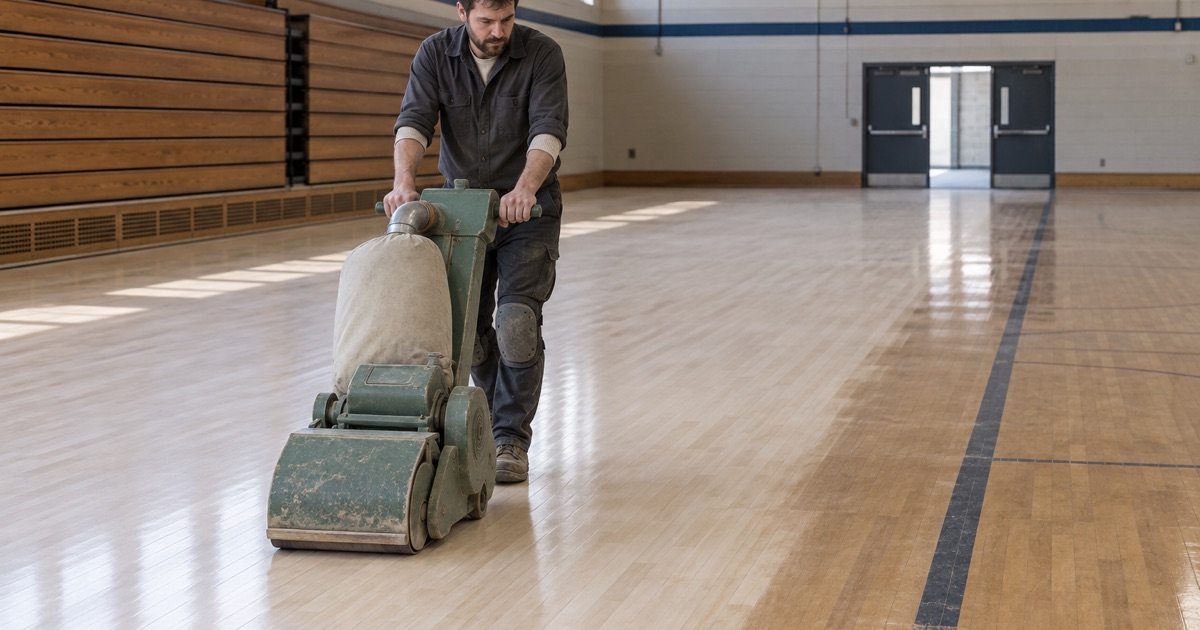
Hard Maple and the Subfloor System Beneath It
Northern hard maple is the standard for sports flooring because it is dense, closed-grain and consistent, which is what gives a playing surface predictable ball response and even wear. Underneath, the flooring sits on a resilient subfloor assembly rather than directly on the slab, and that assembly is what provides shock absorption. Neither part can be assessed by looking at the finish. Older facilities may have a sleeper system on the slab, newer ones a pad-and-panel or channel assembly, and the difference changes what a repair involves and how the floor moves seasonally, so we establish which one is under the maple before quoting.
The Perimeter Expansion Void and Why It Gets Covered
A gym floor is designed to grow and shrink seasonally as a whole panel, which is why a gap is left at every wall and covered with a vented base. Buildings close that gap over time — a bleacher installation, a wall base replaced by someone who did not know, debris packed in. When the floor grows and has nowhere to go, it buckles. Checking the void is the first thing we do, and reopening a closed one is often the whole repair — a floor that lifted in August because its perimeter was packed solid will lie back down once it has somewhere to expand into, without a single board being replaced.
Recoat Cycles and Full Refinishes
The Annual Screen-and-Recoat
Most facilities are best served by abrading the existing finish with a screen and adding fresh coats each year, which restores gloss and slip characteristics without touching the maple. It is fast, it is comparatively cheap, and critically it spends none of the floor’s remaining thickness. A building that maintains this cycle rarely needs a full sand for anything other than a game line change.
When a Full Sand Is Genuinely Required
A full sand is warranted when the finish has worn through to bare maple in the traffic areas, when the floor has been allowed to go too long between recoats, when there is staining that abrasion will not lift, or when the game line layout is changing. It is a bigger job in every dimension — time, cost and thickness spent — so it is quoted as the exception rather than the default.
Game Lines, Logos and Layout
Documenting the Existing Layout Before Anything Is Removed
Game lines disappear in the first pass of a full sand, and after that the only record of where they were is whatever was captured beforehand. We photograph and dimension the complete layout, including line widths, colors and the position of every logo and key, before the sander touches the floor. That record is what makes an accurate restoration possible rather than an approximation.
Laying Out New Lines and Applying Them
New or revised layouts are set out and measured against the dimensions the governing body for the sport publishes, then checked before any paint is applied. Lines go down after the sealer and before the topcoats, so the paint is encapsulated rather than sitting exposed on the surface. That sequence is what stops lines from wearing off in the first season of play.
Scheduling, Moisture and Building Conditions
Working Inside a Building’s Calendar
The schedule is usually the binding constraint. School gyms have summer windows, churches have weekly commitments that do not move, and community facilities have bookings taken months ahead. Cure time is not negotiable, so the only honest approach is to work backwards from the date the floor has to be usable and say clearly whether the available window supports a recoat, a full refinish, or neither.
Humidity, Slab Moisture and Seasonal Movement
A gym is a large volume of air that is often unconditioned over a summer break, and a maple floor tracks whatever that air does. Where there is a slab below, moisture from underneath is the other half of the picture. We read the conditions the floor is actually living in before recommending anything, because a floor refinished into an environment nobody controls will be back in the same condition sooner than anyone expects.
- 20+ Years Experience
- Free Written Estimates
- Dust Containment on Every Sand